Showing posts with label Italy. Show all posts

Sunday, April 27, 2014

Travel Notes Italy


Kufstein: Berlin has become the laughing stock of Europe, for its inability to build the new international airport. The BER originally was scheduled to open southeast of the capital in 2012, but the opening has been delayed due to faulty fire prevention systems and other logistical fuck-ups. Planning councils and construction managers came and went. The current manager’s main goal seems to be to NOT commit to an opening date, so he won’t get blamed for not meeting it. Our waiter in the local food restaurant in Kufstein, Austria, upon hearing we were from Berlin, told us that at this point it would probably be easier to tear down Berlin and rebuild it next to a functioning airport, than to finish BER. Haha.

We had a heavy, southern dinner - Spätzle, roast deer and the likes. Kufstein is a small town on the Inn River, with a mighty castle on a huge riverside rock towering over everything. The river was the only way to get through this part of the alps, and apparently the castle on the rock was used to blackmail heavy taxes from those trying to pass through. 

Late that night, Rory got locked out of the hotel when he went to get something from the car. After a while he slipped back in, behind a group of freaky people wearing something like part lucha libre/ part heavy metal outfits. We decided, once and for all, that Austrians are weird. Their airports are nothing to write home about either, right? Have you ever had to stop at an Austrian airport?


Montegabbiano: The thing I love most about central Italy is that you can drive off the highway at any point, follow the most intriguing road up the hill and then look for a sign that says “Agriturismo”. You drive up some dirt road to an old farmhouse, and you will get a cute, cozy room and a dinner made from food all produced on the premises. I have never been disappointed with this travel method. You don’t need a reservation, because there a so many of these places, and they are all good. On our way down to Southern Italy this time we stayed at this little place just across the Tuscan Umbrian line, in the province of Orvieto, called Il Gatto Giallo. The owner of this well-run business was a good looking young man named Alessandro, who appeared to be about 22 years old. Despite the fact that the restaurant had catered the police departments of the three surrounding towns for the local election that day, and had a dinner party of 15 headed by a big shot journalist that night, they dragged two extra beds into the last remaining apartment and fed us a dinner of homemade prosciutto, cheese and salamis, roast duck with fave beans, linguini with fresh crab and their own wine. It rained hard all night. In the morning we got hot brioches, fresh fruit and the best coffee I had in years. 


I took an early morning walk from the Agriturismo.
A view of solar fields and beyond.


Hedge Dolphins


And off to the south we went.

Battipaglia: when we first drove through this southern Italian city on our way to the beach town of Santa Maria, it felt distinctly like being on our way to San Carlos in Mexico. Run down stores, feral street dogs, garbage, peeling signs, abandoned buildings, all this right next to the fields that grow much of the vegetables for people and countries north of here. 


Italy (along only with Spain and Greece) features all three economic development categories created by the EU. These are determined by how a region’s per capita gross domestic product relates to the EU average. The categories have fancy names, but essentially they describe poor, developing and rich. The “poor” category means the region is under 75% of the average GDP – this is true for all five southern Italian states.  As a result, more funding goes to these areas, as part of the EU Structural and Rural Development Funds. You’ll see the “made possible by EU funds” signs featuring the golden stars on blue everywhere: bridges, roads, archeological sites, restored buildings, small business start-ups, environmental clean-ups, you name it. Despite the money, (29 billion Euros over the next 7 years for Italy) and the resulting infrastructure projects for the area, Italians have grown weary of the EU, and especially the austerity policies imposed by Germany on the failing EU economies. We saw this poster for the upcoming EU Parliament Elections.


The group Italia dei Valori, advocates for Italy remaining in the EU, but for not “becoming Germany”.

Anyway, Battipaglia was ugly, and we were glad to go south to Santa Maria, which is much prettier. The region has one thing going for it, economically, and that is Mozzarella made from Buffalo milk. Several large farms are located along the road between Agropoli and Battipaglia. This cheese, no older than three hours when you buy it at the store or the farm, is the best, most subtly creamy tasting dairy product you will ever have.

But the next day, when we drove back up that way to pick up Charlie from the train station, a Mozzarella truck hit us from behind, putting a huge dent in the brand new rental and a big shock into the kids. Unphased, a few days later, we drove that way again and visited one of the Mozzarella farms, petted the gentle buffaloes and had buffalo yogurt.


Cilento: This whole area, sort of the peninsula south of the gulf of Salerno, is called the Cilento, and it is very, very beautiful. It is a UNESCO world heritage site, and includes Paestum, and ancient greek settlement which was later taken over by the Romans. You can see greek temples next to the foundations of Roman houses. 


Castelabbate is one of the most beautiful medieval mountain top borgos in Italy, with its little viccolos and breathtaking views down to the valley and the Mediterranean Sea at sunset. 
View from Castelabbate-
This totally looks like the ocean should be flooding into the valley

Santa Maria below is the little seaside town where I had found a beachside condo complex that on the internet looked pretty close to our beloved Condominios Pilar in San Carlos, Sonora, Mexico. It was indeed nice, with a big pool, a clean beach and a simple condo. The difference: it cost four times the rent and the resort was completely inhabited by Germans with tons of little kids, who were entertained by a child care person that was part of their travel package. It was totally like being in Berlin Prenzlauer Berg. To complete this impression, it rained most of the time, too. Oh well.

Santa Paolina: The hometown of Charlie’s grandfather Giovanni Aufiero, located in the beautiful green mountains of Campania, has 1,500 inhabitants today. Never a center of major economic activity (between 1880 and 1920 more than half the male population from here migrated to the US, fleeing extreme poverty, natural disasters and overpopulation), this time we felt and heard about “la crisi”, the recession, and how it affects everyone, including the people in our extended family here. 

Charlie’s cousins, all retired from public service jobs and living in their own houses, are doing fine. But those of their children who remained here, and who are now in their thirties and forties, are unemployed, underemployed or without a way to improve their economic situation. Our cousin Agata had to pull her daughter Marianna out of the local elementary school, named after her own late mother, because there were only six kids left in her 2nd grade class, and she was being taught the same stuff as the first graders. Her dad Luigi is down to working 5-6 days per month for a subcontractor of the FIAT factory in nearby Avellino. Almost no young people are left in Santa Paolina. People talk about migrating again, this time to Germany. After talking to the other cousin (also named Agata, distinguished by the adjective “piccola”), who never finished her law degree after getting pregnant with her daughter, I could feel the collective depression the village is in – she halfheartedly assured me she would continue to study after the baby starts going to daycare in September. Towards what future was not apparent….

To this day, people here love America… and dislike the Germans. Cousin Felice, the official town historian, showed us the evidence of the switching of this particular alliance in 1945: the blacked out house number on this old building in Santa Paolina featured the sign of Mussolini’s fascist party. It was quickly painted over during the hours between the retreat of the German troups and the arrival of the Americans. 


Immediately after the end of the war, the family members that had migrated to New York sent care packages to Santa Paolina every few days. In the fifties and later, the expatriate Italians sent money to pay for the floors and the stained glass windows of the church, and for the annual Festa of the Santa Paolina. Ties with the US are strong to this day. New Americans show up several times a year, trying to find their family roots. Felice helps most of them, despite his total lack of English.

One ancient man we talked to in the street, unaware of our German origins, said that Germany had taken over the world with military means in the 1930ies, and was now doing the same with economic means through the EU. It was like his horrible historic memories had come full circle.  Meanwhile the EU helps to pay for the village water drainage system, assuring that the whole place doesn't go downhill with the next rain. That's not as popular as church stuff, I guess. 

Santa Paolina church community getting ready for the procession
 of the Madonnina del Rosario on Easter Monday

Fano: On the way back up north, we decided to check out the “east coast” and stopped in a totally nonfamous town called Fano, just north of Ancona. We checked into a seaside hotel and after an affordable seafood dinner slept to the sound of the Adriatic sea. We spent the morning walking around the historic center of this buzzing, lively town, which combines a seaside port, ancient roman walls, beautiful renaissance architecture, a huge market (apparently on Wednesdays, we were lucky), surprising numbers of inhabitants on bicycles, and tons of cool little stores, cafes and bars. No tourists. Which proves again that traveling anywhere off the beaten path in Italy is so much more rewarding than the Venice-Florence-Rome stress tour.
Bressanone/Brixen: Going back north towards Germany, you have to pass though an Alpine region called Alto Adige or Südtirol, in German. It stretches across Italy and Austria and is bilingual Italian and German. You would think that this eases one back gently into the German world, but it really is quite sudden and feels uncomfortably more German than Germany. This area is very much hidden away in the mountains, conservative, old style, and the southern dialect sounds funny to the kids. Brixen is a pretty historic town of 20,000, still in Italy, surrounded by snow-covered mountains, featuring a huge cathedral, picturesque town square and expensive stores catering to the wealthy mountain climbing and skiing crowd. Tired of driving, we stopped and checked into a little Gasthof where we also had a simple dinner.

Tomorrow night we will be back in Berlin – the capital of the most powerful and wealthy nation in Europe, of the EU bully…..that still can’t figure out how to finish building its airport.

courtesy by Sven Giessen,
found here:https://plus.google.com/+SvenGiesen/posts

Wednesday, October 2, 2013

FAQs Month 4

Are you acclimated yet?
Mmmh….I totally enjoy being here, love the mix of the familiar and unfamiliar, the old and the new. It's all very interesting, engaging, and challenging. And somewhat puzzling, especially how I'll fit in here as a professional. I mostly see family, and not very many friends, but so far I am fine with that. And guess what: There is such a thing as fall here. Autumn! Incredible colors, fresh earthy smell, golden days. That said, I don't think I'll ever completely acclimate anywhere. But that's just me. I like having the view all around from on the fence. Part of the global homeless tribe. There are lots of us in Berlin.

How are the kids?
Ruby, unexpectedly, is having the hardest time. She got handed the worst school deal, too: Her 8th grade class is one of two classes to form a the second public international school in Berlin, because Nelson Mandela School has reached its limits in terms of size.  But now no one feels responsible, the district hasn’t hired people or made plans for new the school, and the mothership school doesn't seem to care.  So they're stuck in subleased rooms in another school, with no perspective and no connection to the great big school community over at the main Nelson Mandela building.  Parents are now in the process of organizing and advocating – for what I am not sure yet. Ruby’s classmates took some getting used to for her - more girly-girls than Ruby's friends in Silver. All the time she spends on facebook is not helping.

Rory is doing very good, he is attending the college track (IB) program at Nelson Mandela, and it's structured like college, and he'll be able to go to the university anywhere in the world after two years. He has lots of time he can choose how to structure. It's a little scary but seems to work so far. And he has been hugely creative, both with music production, and with working on his longboarding skills. Both count towards school. He also volunteers in a cat shelter, which also counts towards school. Right now he is down with a sprained ankle.

Ben misses his father (not this month, because Charlie is with us), and his friends, but enjoys it here otherwise. He loves his school, and he is starting to make some friends in the hood and gets play dates through other family and friends. He is playing baseball and is on a swim team. He has lots of catching up to do academically before he can enter 4th grade (and not because school is in German), as we feared. I get to do childhood memory things with him, like collecting colorful autumn leaves and chestnuts, and making little animals out of chestnuts and matches.

Is the US officially the most dysfunctional democracy in the world?
Certainly in the eyes of its citizens. But if it’s any consolation, Italy (where we are headed for fall vacation on Friday) is doing worse. Somehow this week they managed to get their whole government to crumble over the power games of ex-head of government Silvio Berlusconi - a convicted felon and crook, who not only owns most of the media outlets but also many politicians. Where the US suffers from the two-party system, Italy suffers from too many parties, and the subsequent intrigues and constantly changing alliances. Germany just had elections two weeks ago, largely unnoticed by the rest of the world, because the results will keep Chancellor Merkel of the Christian Democrats (CDU) in power. That’s the only thing staying the same, though: Her new government will be a new coalition (yes, as in, representatives of different parties agreeing to govern together, sharing cabinet and committee appointments). The coalition will be composed of either CDU and Social Democrats or CDU and Green Party. Very different from the previous partner, the neo-liberal FDP which voters kicked out of parliament with a big bang. So the coalition talks are starting, and may take quite some time. Even though Germans are complaining about the related political posturing and how long the whole thing takes, it seems to me that this is pretty functional democracy at work.

Back to the US: The news we get from there (thanks to NPR Berlin) sounds like reruns from a year ago: Mass shootings and Republicans trying to repeal Health Care Reform. Really? A law that was passed three years ago, by a president who was since re-elected. Don’t get me started.

Are you working?
Little by little. Mostly I am still learning, reading, attending workshops, talking to people. I have a few consulting engagements, and I am working with an awesome consulting firm to put together a series of seminars on strategic philanthropy. There is a word here which describes the prevalent German grantmaker approach: Projectitis. More on what I learned about the German NPO sector will be a separate post soon.

Can we come visit?

Be our guest. You can see this:

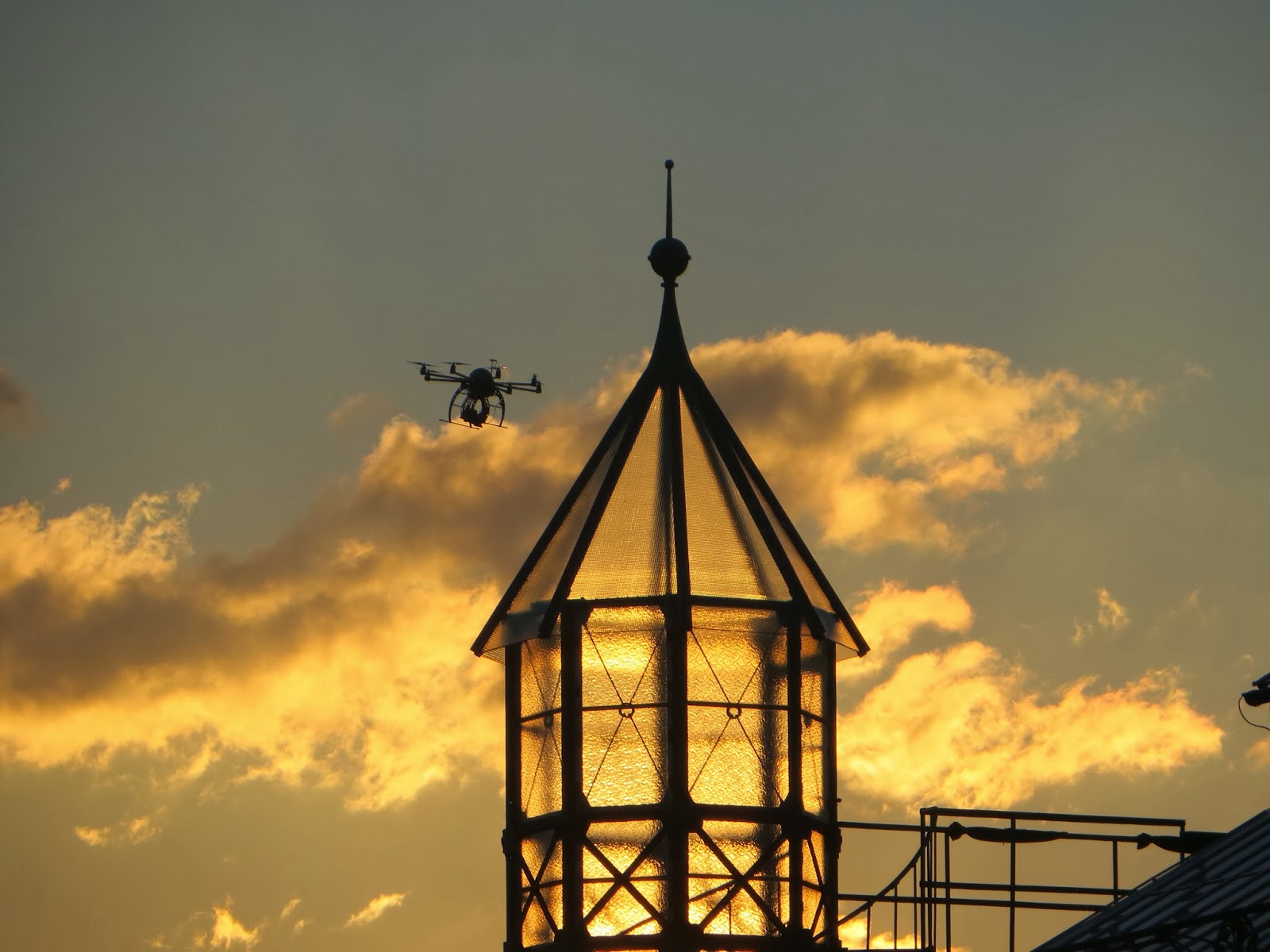
Autumn sun going down behind the botanical garden greenhouse - see the guy on top? He is dancing.
..and then there was this little helicopter thing buzzing around. What is it?


Thursday, August 29, 2013

Stop Monolingualism!

I find this ironic: I left the mono-cultural, homogenic little Germany twenty years ago, to move to the melting pot, heterogenic, multicultural US. Now I moved back here, to find a true, buzzling global city. 

On a regular subway ride in Berlin these days you are guaranteed to hear conversations at a minimum in English, French, Arabic, Turkish, and Spanish. Often Russian and Polish, and very often one or two additional mystery languages you can’t identify. German? Not so much. Germans tend to be quiet and grumpy on the subway.

Ruby and Rory now go to Nelson Mandela International School in the center of the old Westberlin. This year, students from 54 countries are attending, speaking I don’t know how many languages, the common one of course being English. But ALL these kids are multilingual. I am really happy that my kids get to be in this environment. Ben attends the neighborhood elementary school, and at the parent night this week I spotted two African families, one Polish mom, a Brazilian-German family and another one from Spain. (In addition to a double-dad family, which is cool, but off-topic here…but anyway, congratulations to all my same sex friends finally getting married this week in New Mexico!) Ben’s buddies are starting to study English this year, in third grade. During the English classes, the principal has agreed to work with Ben on his German writing skills.

When I first heard the term “bilingual” in the US I didn’t understand or use it correctly, because in German “zweisprachig” means that someone grows up speaking two languages and masters both equally well. It doesn’t apply to someone learning a second language in school or later in life. Zweisprachig is a higher standard than bilingual. Which may be symptomatic with what is going on in language education and the culture of monolingualism.

I don’t get why there is not an expectation in (many parts of) the US that children learn a second and third foreign language.

When Charlie grew up in an Italian neighborhood in New York, speaking one’s native language was considered a bad thing. It was a sign of failing to assimilate. He was 12 years old until he realized that his dad spoke Italian. The family had to hide the fact that they spoke German at home, this being less than ten years after the end of WWII.

Native American youth in state boarding schools for decades were prohibited from speaking their native languages. We can’t even begin to assess the damage done to the cultural identities and oral traditions of those people and their entire tribes. They are just lost forever.

I heard many Hispanic people in southwest NM communicate in Spanglish. I find no beauty in that tongue, which mangles both languages, much like the Türkendeutsch (Turkish-German) I heard immigrant kids speak when I was growing up in Berlin. There are no consistent Spanish classes offered in public schools, no way for youth to learn the beautiful language of their heritage, and to read Fuentes, Borges, Rulfo, de la Cruz and Paz.

So why is it that immigrants and their descendants in the US try so hard, and/or are coerced so hard to lose their mother tongue? There is not much social, cultural and educational value placed on speaking more than English.

In Northern Europe, on the other hand, you don’t even get admitted to any educational institution above 7th grade without speaking 1-2 foreign languages. It is just considered part of a well-rounded, basic education. There is no choice about it. It made it a challenge to find schools for Rory and Ruby in Berlin that could accommodate their lack of a 2nd foreign language. Now they are at the International School, and Ruby is finally learning French.

Many people in the US have asked me with awe how many languages I speak, and when they hear the answer (four, through no specific effort of my own), they respond with sighs of envy and resignation. My kids, who all speak passable German, again just because they heard it spoken at home, are almost considered little geniuses. Come on. Why not up the ante for your own kids?

If it is true that the language we speak both reflects and affects our view of the world, then this leads to the hypotheses that if we add one language or more, our view of the world broadens and gets enriched. As will our life. Let’s break this down.

Benefits of Bilingualism

Enhanced brain development - early learning of a language makes it easier to learn all your life. Bilingual kids have an easier time to learn math, for example, which from a learning brain’s perspective, is just another language.

Widening of the perceptive horizon - being bilingual helps you better understand concepts from differently thinking cultures and be more open to step out of your own thinking box. For example, Spanish and Italian both have a remote past tense, so English and German speakers’ brains are challenged with distinguishing not so far away past from remote past. Most languages other than English have genders (male, female, neutral) for each noun. In her intensive German course Maddy learned about the German cases (Dativ, Accusativ, etc.) which determine how you declinate verbs and personal pronouns. It’s like the colors that the butterfly sees, that we don’t even have words for.

Better chances in employment in a global economy - Good luck trying to land a job in international commerce, development, or government with just English.

And btw you’ll come off less as a full-of-yourself American who assumes everyone speaks English when traveling abroad. Bilingualism opens up people, as well as their art, culture, history in countries ten times as old as ours. My friend Ed Ward,  part of a new tribe he named American-Europeans,  has now lived in Europe for a third of his life. He will attest to the fact that you can't truly immerse without at least passably mastering the native language. Ed writes about his version of daily intercultural shock (and his 20th anniversary of moving to Berlin) very aptly in this post, and anyway, you should totally follow his blog, which complements this one well.

Continuing on to the.....

Effects of Monolingualism

We (or your kids, for that matter) remain stuck in our own limited culture box, don’t look past the US border, or even over into the next ethnic neighborhood. We can’t communicate with non-English speakers when traveling abroad. We’ll never go to school outside the US and will never be employed at a global company working in other countries. And: Monolingualism breeds monolingualism. If the value of bilingualism is not experienced by the parents, they’ll be less likely to support their offspring in achieving it.

Of course, you, the estimated reader, and all your progressive friends really do know all this. Many otherwise educated US citizens have a sense of national inferiority because of the culture of monolingualism. What I don’t get is why nobody does anything about it. Why don’t tax and tuition paying parents demand language education? Why is this particular issue met with such self-defeating resignation?