Showing posts with label education. Show all posts

Tuesday, December 30, 2014

Middle Class Where Goest Thou? (A Tale of Fear or Solidarity)

My friend Ed Ward, who moved back to the US from Europe a little more than one year ago, provides his first year in review here. Like me, he is on the fence – some things are good and some things European he misses (food prices!). He is still “broke, not poor”, if a little less so. I like his motto, which he has promoted for many years, and which is an expression of hope that this state we are in is a temporary one.

As a recently turned single (-income) parent I myself have changed from very affluent to pretty strapped financially – supporting half the number of family members at this household on 20% of the former combined salary and not a single asset to call my own anymore.  A little scary at age 50. But thanks to supportive friends, family and employer, and a socio-economic system that assures health care, retirement and education (and no, it’s not free, I pay taxes and contributions for it) – thanks to all that, we manage quite well.  And we will soon start to pass on the solidarity and add a member to the household, probably a young student from a less fortunate country. So I’ll change Ed’s motto to “poor, but fortunate”.

Not everyone here feels this way. A small, but growing number of people in Germany could now be described as “still pretty fortunate, but vaguely pissed off”. Yes, Germany now has its own Tea Party! A new social movement called Pegida, which stands for patriotic citizens against the “Islamisation” of the occident. Really, the occident.  Pegida and their especially inept and shady leaders (reminds one of Sarah Palin and the likes) provide much amusement to the media, comedians and the twitter community. Yet, every Monday they meet in growing numbers (last rally had 17,000) in Dresden and now in other cities, and protest – not sure what exactly…. since foreign nationals of Islamic faith comprise something like 1.2 % of the population of that state, Sachsen. Pegida people chant “We are the people”, copying the peaceful revolutionaries of 1989 East Germany. And they march for peace - but I am not sure what kind of peace they are thinking of.  The peace of a racially homogenous society, maybe. They are a bunch of ignorant dimwits, just like the US Tea Party. But they come from the same environment of middle class fear that the Tea Party emerged from.

And they do worry the shit out of the political establishment. This week, voices from the ruling party CDU emerged, saying that the traditionally conservative CDU moved so much to the middle, to social democratic policy positions, to an open society welcoming refugees, and to embracing the EU, and as a result they have lost some of the more right wing constituents on the way. This is probably a somewhat accurate description of what happened here. Is the reaction of the CDU and the AfP (that's our new Anti-EU Party) going to be what the GOP did in the US, which is embrace the Tea Party and let it take over? I doubt it.  Of course in Germany, we worry about right wing, racist movements way more than we do in the US.

And on the US side of the fence? Tom Schimmeck, a columnist with our local paper who loves and is very familiar with the US feels after a recent visit that the spirit of the citizens has been broken – the dishwashers don’t believe the millionaire story anymore.  He says that while the economic statistics are promising, the current recovery and economic growth happens without the middle class, which is now 40% poorer than before the recession. Income inequality continues to rise, and education has become just another for-profit line of business, just like prisons and health care. (Btw- our little family is looking forward to welcoming the first educational ‘refugees’ from Silver City next fall.)

It’s true- looking at the US from this side of the fence is totally depressing these days. The persistence of structural racism evidenced by police violence and a failing justice system, the report on CIA torture and subsequent discussions, the result of the recent elections, and the loss of all the progressive enthusiasm of the first Obama years. The hope we had that policy may be about people again – health care reform about healthy people, immigration reform about hard working families –gone. Instead, corporations are now considered people and propaganda and the influence of money on policy is now considered protected free speech. And the next elections? Bush III vs. Clinton II ? Money rules.

I think living in a small, predominantly progressive community like Silver City for all these years made it easier to handle- you could always rest assured in the warm community spirit and believe that the country had not completely gone to shit, and then rant of facebook about all the bad things from a protected place. I don’t know whether this is good or bad or both.  Is it collective illusion or a supportive oasis, where we make small local improvements, when we can’t affect the big picture anymore?  


Benny, at age 10 and living again in Silver City, loves it there, but he also worries about the people in Sudan and the refugees from Syria living in Berlin. And on Christmas Eve he cries and wonders why he is so privileged and others are so poor, sick with Ebola or displaced by war. It affects him deeply, emotionally. Us socialists here in occidental Europe call that solidarity.  I am proud of my middle class global citizen son.


Sunday, March 16, 2014

Surviving Secondary Education

One of the reasons we moved to Germany was for our kids to get exposed to an education system with higher expectations. I wanted for them to get a good basic body of knowledge and skills from school. That part totally worked, the expectations are higher,  they are learning a lot, even though we buffered this by putting the two older ones in an international secondary school and Ben a grade back at the neighborhood elementary school.

They are all struggling with school in their own ways, and all managing quite well. I am glad they are having to establish study habits, manage their time and do a good job. That sounds trivial, but in NM I felt nobody had instilled the expectation that you not only complete an assignment on time, but that it is well done, looks good and it has been edited and fine-tuned. Or that you keep good notes in an organized binder (which will later serve as you study guide). In NM, my kids always had a bunch of dog eared pieces of paper stuffed into their backpack or their cubby at school. Here, kids get a grade on their binder.

Apart from these improvements, the education system and the schools here are far from perfect, unfortunately. And years of intense involvement in my kids’ school in the US have left me with little energy to do the same here. I just kind of wanted to lean back and know that the system works. Not happening. We are thinking about a different school for Ruby, for reasons that have nothing to do with her performance and everything with the school’s performance.

Ruby is part of a public school experiment (the Nelson Mandela International School) and within that, part of the second international school being spun off from the first one. The whole process has been mired by jaw-dropping levels of incompetence at the school administration level: Of all the components you and I know are needed to start a new anything, they had exactly zero: No plan, no leadership, no staff (other than teachers), no building (other than two sublet classrooms a 30 minute walk from the main building), no infrastructure, no steering committee (until recently) no division of labor and no assigning of responsibility.

Teachers, students and parents, when this lack of everything slowly dawned on them, had to take over. When you do this, when you speak up and you try to compensate for the lack of activity by doing something (like, the teacher brought her own cell phone hotspot, so the classes would have internet, the parents organized recess supervision, wrote letters etc.) of course this is not received well, because your activity will reveal the lack of competence of those really responsible. Moron exposure, not a happy thing. So then, conflict arose between the school and the parent community, which is now hopefully morphing into some kind of collaboration, but certainly not built on mutual trust yet. 

Remains to be seen if it turns into a viable school before Ruby’s secondary years have passed. Her class has shrunk to 11 people, which of course creates a dream student-teacher ratio. But Ruby's circle of friends is rather small as a result. Meanwhile I joined the steering committee, with a big sigh. Do I have the patience? Not really, and anyway, I didn’t come here to start a new school, and while some parent involvement is great, I still believe in the concept of paying taxes so public schools give my kids a decent education (and only if that doesn’t work, move, or pay tuition to a private school). So Ruby and I are reviewing our options.

Generally, high school seems to have gotten a lot harder in Germany over the last 30 years. While each Land (sort of the German states) is different, due to a federalized political system, I think this is true all over the country. I remember sailing through Abitur with not a whole lot of effort 30 years ago. Today, the content of higher level secondary education (Gymnasium), which ends in Abitur, is squeezed into two, instead of three years in many of the Laender. Students and parents complain that there is no life outside of studying. I see that with some of my friends who have children in Gymnasium: They spend a good chunk of their family weekend on homework and studying for exams. 

It goes on at the university, which has become more school-like, with tons of tests and exams, very structured curricula, all this since Germany changed degrees and grades along the lines of European reform, which included adopting the US bachelors/masters system. So, people complain it’s more measurable, test-ible knowledge and data squeezed into one's head, and less thinking, independent research, group work, project work – less of the competencies that makes us capable to continue on a path of livelong learning.

I have heard quite a few people remark recently: Almost everything I learned in high school I have never needed in real live ever again. And now school in Germany teaches even more academic stuff that our kids won’t need, as part of that core curriculum of secondary education. There is the argument that you should learn these things to train your brain to learn, so you can learn other things that you will actually need later. But what is even the point of memorization, when there is no context for what you memorize? You will forget it immediately after the test.

Knowledge that we apply on a regular or even occasional basis will stay in our head because it is relevant, because it is connected to something meaningful or useful. Instead of high level calculus, can’t they teach kids to do a tax return, navigate healthcare.gov and use excel and bookkeeping software? That would save a lot of money and grief later in life. Teach them foreign languages. Teach them skills and study habits, so they know how to organize thoughts and research, how to understand what they read and how to write so other people can understand. Teach them how to work on their own and as part of a team. How to speak in public and to advocate for something they feel passionate about. Finally, along with all these competencies –and I think this is the high end art of being an impactful teacher - do not kill your student’s curiosity, but nurture it. Help you student succeed.

The other day I heard this on NPR’s Fresh Air, from an interview with astrophysicist Neil deGrasse Tyson:
Dave Davies: I read that you were recently asked to give, I think, a commencement address at, was it your elementary school, and declined. Did you feel let down by the public school system when you were a kid?
Tyson: Oh, no, no. So everyone has all different experiences in school. I just know that throughout my life, at no time did any teacher ever point to me and say, hey. He'll go far. Oh, he's someone you should watch. You know, I had some OK grades. They ran the gamut. I had some high grades in math and science, and medium grades in other subjects, and slightly lower grades in other subjects. You've got to remember, the school system is constructed to praise you if you get high grades. And if you get straight A's, you're the one that everyone puts forward, and they prognosticate that the straight-A person is the one most likely to succeed, because that's the way the school system is constructed and conceived.
And there I am, getting grades all over the place, but I know my interest in the universe and I owned a telescope that I bought with money I earned by walking dogs, because I live in a huge apartment complex. And 50 cents per walk, per dog, and that accumulated quickly. I bought a camera, a telescope. I taught myself astrophotography. I did all this.
I took classes at the American Museum of Natural History at Hayden Planetarium, advanced classes for adults in modern astrophysics. I did all this, but none of that showed up as a high grade on an exam in school. So, there I am, and teachers complaining about my social energy, as though that was something bad, and, oh, he's disruptive. Not purposely, I just had energy, right.
So my elementary school wanted me to come back - because I was already well-known by then - to talk and say what a great education I had. I said no. That's not the talk I would give. I would say I am where I am today not because of what the teachers said about me or did for me, but in spite of it. And I don't think that's what you want, so I will decline. Invite me back one day, and I'll talk just to the teachers, all right, and then I'm happy to tell - give - you know, tell them what they should be looking for, perhaps, in their students.
Also consider - now, see you've got me started here. Also consider that if you have a straight-A student in your class, that student has straight A's not because of teachers, but in spite of teachers. That's what having straight-A means. It means you do well, no matter the teaching talent of the teacher. That's what straight A's mean. So if you're a teacher and you put forth your straight-A student as though you had something to do with it, you are deluding yourself. The greatest teachers are the ones that turn a B student into an A student, or a failing student into a B student. Then let's talk about your teaching talents.
I agree with Tyson, and I see how inquisitiveness, curiosity and hunger to learn about things kids are interested in, are in direct competition (for time, attention and energy) with the core curriculum and its contents that my high school age kids are expected to hammer into their poor teenage brains.

Rory does not get good grades for teaching himself Ableton, a complex music production software, doing extensive music history research, organizing a library of samples, learning the base guitar, learning drums and producing an ever improving body of musical work over the last seven months. I do have to admit, the IB program he is in (the international high school degree, as opposed to Abitur), at least acknowledges his creative work through the Creativity, Activity and Service (CAS) component. Students keep track of their hours in these areas and it becomes part of their final score for graduating. But instead of just keeping time sheets about stuff you love to do, these talents and passions could be celebrated and supported in many other ways. And other students, who are maybe not as driven as Rory, could be supported in finding their service and creativity opportunities.

My biggest concern with public school beyond 10th grade here is the sort of sink or swim attitude of many teachers. Students in Germany can finish school after 10th grade here, with the Middle school Degree (MSA), and then move on to a technical or vocational career. If you stay in high school beyond this, you are expected to be entirely self-motivated. In a mass letter you receive when your child has unexcused absences (my fault in Rory's case, because I didn't submit the excuses), the coordinator states: "We do not want to unnecessarily prolong your child's education". Excuse me? That, precisely, is your fucking job, if you would only choose to deem it necessary.

The Nelson Mandela IB program requires said study skills, enormous discipline, and in year 12, essentially 100% of the students’ time. It’s a rigorous academic curriculum, comparable to the first 1-2 years of college in the US. For students to master this, however, Nelson Mandela school provides hardly any support from teachers, coordinators and advisors. In fact, they tend to be late, uninspired in their teaching methods (long, droning history lectures), badly prepared, and unable to exhibit even basic communication skills. They do not model the behavior expected from their students. If students are not fully motivated, or experience difficulty academically, there is no support.

Neil deGrasse Tyson would have a stern talk with those teachers. I don't get why these people even are teachers. I would think it’s too stressful and intense a job if you are not good at it and you don’t love it. But maybe they figured out a way to sail through and not feel responsible for the students left behind. I wouldn't want to unnecessarily prolong their teaching careers.

There is no one system that works great, and what I knew already in the US is true here as well: Your parental job is to put together the best possible education menu from available public and private resources for your kids, and complement whatever they are not getting yourself. And you have to support them and encourage them, for the whole 12 years. You have to teach them to function well within badly designed systems. And tell yourself that that’s a good skill to learn in itself, because it’s one of those you will need for the rest of your life.

P.S. I’d like to see your comments on this…. What do you think school should teach students by the time they graduate? How hard should they try? What’s not the job of the school, but of parents and community?

Wednesday, October 2, 2013

FAQs Month 4

Are you acclimated yet?
Mmmh….I totally enjoy being here, love the mix of the familiar and unfamiliar, the old and the new. It's all very interesting, engaging, and challenging. And somewhat puzzling, especially how I'll fit in here as a professional. I mostly see family, and not very many friends, but so far I am fine with that. And guess what: There is such a thing as fall here. Autumn! Incredible colors, fresh earthy smell, golden days. That said, I don't think I'll ever completely acclimate anywhere. But that's just me. I like having the view all around from on the fence. Part of the global homeless tribe. There are lots of us in Berlin.

How are the kids?
Ruby, unexpectedly, is having the hardest time. She got handed the worst school deal, too: Her 8th grade class is one of two classes to form a the second public international school in Berlin, because Nelson Mandela School has reached its limits in terms of size.  But now no one feels responsible, the district hasn’t hired people or made plans for new the school, and the mothership school doesn't seem to care.  So they're stuck in subleased rooms in another school, with no perspective and no connection to the great big school community over at the main Nelson Mandela building.  Parents are now in the process of organizing and advocating – for what I am not sure yet. Ruby’s classmates took some getting used to for her - more girly-girls than Ruby's friends in Silver. All the time she spends on facebook is not helping.

Rory is doing very good, he is attending the college track (IB) program at Nelson Mandela, and it's structured like college, and he'll be able to go to the university anywhere in the world after two years. He has lots of time he can choose how to structure. It's a little scary but seems to work so far. And he has been hugely creative, both with music production, and with working on his longboarding skills. Both count towards school. He also volunteers in a cat shelter, which also counts towards school. Right now he is down with a sprained ankle.

Ben misses his father (not this month, because Charlie is with us), and his friends, but enjoys it here otherwise. He loves his school, and he is starting to make some friends in the hood and gets play dates through other family and friends. He is playing baseball and is on a swim team. He has lots of catching up to do academically before he can enter 4th grade (and not because school is in German), as we feared. I get to do childhood memory things with him, like collecting colorful autumn leaves and chestnuts, and making little animals out of chestnuts and matches.

Is the US officially the most dysfunctional democracy in the world?
Certainly in the eyes of its citizens. But if it’s any consolation, Italy (where we are headed for fall vacation on Friday) is doing worse. Somehow this week they managed to get their whole government to crumble over the power games of ex-head of government Silvio Berlusconi - a convicted felon and crook, who not only owns most of the media outlets but also many politicians. Where the US suffers from the two-party system, Italy suffers from too many parties, and the subsequent intrigues and constantly changing alliances. Germany just had elections two weeks ago, largely unnoticed by the rest of the world, because the results will keep Chancellor Merkel of the Christian Democrats (CDU) in power. That’s the only thing staying the same, though: Her new government will be a new coalition (yes, as in, representatives of different parties agreeing to govern together, sharing cabinet and committee appointments). The coalition will be composed of either CDU and Social Democrats or CDU and Green Party. Very different from the previous partner, the neo-liberal FDP which voters kicked out of parliament with a big bang. So the coalition talks are starting, and may take quite some time. Even though Germans are complaining about the related political posturing and how long the whole thing takes, it seems to me that this is pretty functional democracy at work.

Back to the US: The news we get from there (thanks to NPR Berlin) sounds like reruns from a year ago: Mass shootings and Republicans trying to repeal Health Care Reform. Really? A law that was passed three years ago, by a president who was since re-elected. Don’t get me started.

Are you working?
Little by little. Mostly I am still learning, reading, attending workshops, talking to people. I have a few consulting engagements, and I am working with an awesome consulting firm to put together a series of seminars on strategic philanthropy. There is a word here which describes the prevalent German grantmaker approach: Projectitis. More on what I learned about the German NPO sector will be a separate post soon.

Can we come visit?

Be our guest. You can see this:

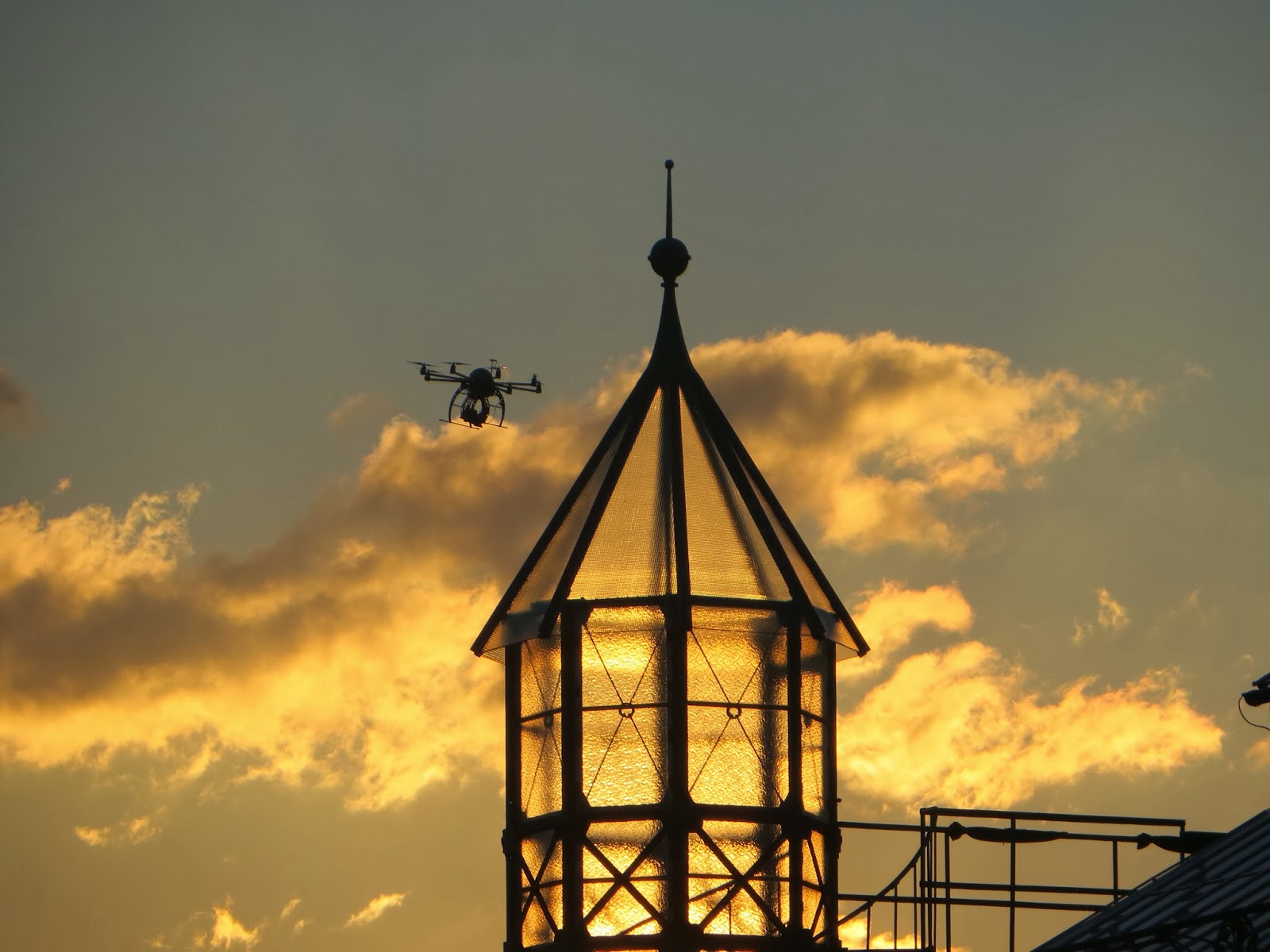
Autumn sun going down behind the botanical garden greenhouse - see the guy on top? He is dancing.
..and then there was this little helicopter thing buzzing around. What is it?


Thursday, August 29, 2013

Stop Monolingualism!

I find this ironic: I left the mono-cultural, homogenic little Germany twenty years ago, to move to the melting pot, heterogenic, multicultural US. Now I moved back here, to find a true, buzzling global city. 

On a regular subway ride in Berlin these days you are guaranteed to hear conversations at a minimum in English, French, Arabic, Turkish, and Spanish. Often Russian and Polish, and very often one or two additional mystery languages you can’t identify. German? Not so much. Germans tend to be quiet and grumpy on the subway.

Ruby and Rory now go to Nelson Mandela International School in the center of the old Westberlin. This year, students from 54 countries are attending, speaking I don’t know how many languages, the common one of course being English. But ALL these kids are multilingual. I am really happy that my kids get to be in this environment. Ben attends the neighborhood elementary school, and at the parent night this week I spotted two African families, one Polish mom, a Brazilian-German family and another one from Spain. (In addition to a double-dad family, which is cool, but off-topic here…but anyway, congratulations to all my same sex friends finally getting married this week in New Mexico!) Ben’s buddies are starting to study English this year, in third grade. During the English classes, the principal has agreed to work with Ben on his German writing skills.

When I first heard the term “bilingual” in the US I didn’t understand or use it correctly, because in German “zweisprachig” means that someone grows up speaking two languages and masters both equally well. It doesn’t apply to someone learning a second language in school or later in life. Zweisprachig is a higher standard than bilingual. Which may be symptomatic with what is going on in language education and the culture of monolingualism.

I don’t get why there is not an expectation in (many parts of) the US that children learn a second and third foreign language.

When Charlie grew up in an Italian neighborhood in New York, speaking one’s native language was considered a bad thing. It was a sign of failing to assimilate. He was 12 years old until he realized that his dad spoke Italian. The family had to hide the fact that they spoke German at home, this being less than ten years after the end of WWII.

Native American youth in state boarding schools for decades were prohibited from speaking their native languages. We can’t even begin to assess the damage done to the cultural identities and oral traditions of those people and their entire tribes. They are just lost forever.

I heard many Hispanic people in southwest NM communicate in Spanglish. I find no beauty in that tongue, which mangles both languages, much like the Türkendeutsch (Turkish-German) I heard immigrant kids speak when I was growing up in Berlin. There are no consistent Spanish classes offered in public schools, no way for youth to learn the beautiful language of their heritage, and to read Fuentes, Borges, Rulfo, de la Cruz and Paz.

So why is it that immigrants and their descendants in the US try so hard, and/or are coerced so hard to lose their mother tongue? There is not much social, cultural and educational value placed on speaking more than English.

In Northern Europe, on the other hand, you don’t even get admitted to any educational institution above 7th grade without speaking 1-2 foreign languages. It is just considered part of a well-rounded, basic education. There is no choice about it. It made it a challenge to find schools for Rory and Ruby in Berlin that could accommodate their lack of a 2nd foreign language. Now they are at the International School, and Ruby is finally learning French.

Many people in the US have asked me with awe how many languages I speak, and when they hear the answer (four, through no specific effort of my own), they respond with sighs of envy and resignation. My kids, who all speak passable German, again just because they heard it spoken at home, are almost considered little geniuses. Come on. Why not up the ante for your own kids?

If it is true that the language we speak both reflects and affects our view of the world, then this leads to the hypotheses that if we add one language or more, our view of the world broadens and gets enriched. As will our life. Let’s break this down.

Benefits of Bilingualism

Enhanced brain development - early learning of a language makes it easier to learn all your life. Bilingual kids have an easier time to learn math, for example, which from a learning brain’s perspective, is just another language.

Widening of the perceptive horizon - being bilingual helps you better understand concepts from differently thinking cultures and be more open to step out of your own thinking box. For example, Spanish and Italian both have a remote past tense, so English and German speakers’ brains are challenged with distinguishing not so far away past from remote past. Most languages other than English have genders (male, female, neutral) for each noun. In her intensive German course Maddy learned about the German cases (Dativ, Accusativ, etc.) which determine how you declinate verbs and personal pronouns. It’s like the colors that the butterfly sees, that we don’t even have words for.

Better chances in employment in a global economy - Good luck trying to land a job in international commerce, development, or government with just English.

And btw you’ll come off less as a full-of-yourself American who assumes everyone speaks English when traveling abroad. Bilingualism opens up people, as well as their art, culture, history in countries ten times as old as ours. My friend Ed Ward,  part of a new tribe he named American-Europeans,  has now lived in Europe for a third of his life. He will attest to the fact that you can't truly immerse without at least passably mastering the native language. Ed writes about his version of daily intercultural shock (and his 20th anniversary of moving to Berlin) very aptly in this post, and anyway, you should totally follow his blog, which complements this one well.

Continuing on to the.....

Effects of Monolingualism

We (or your kids, for that matter) remain stuck in our own limited culture box, don’t look past the US border, or even over into the next ethnic neighborhood. We can’t communicate with non-English speakers when traveling abroad. We’ll never go to school outside the US and will never be employed at a global company working in other countries. And: Monolingualism breeds monolingualism. If the value of bilingualism is not experienced by the parents, they’ll be less likely to support their offspring in achieving it.

Of course, you, the estimated reader, and all your progressive friends really do know all this. Many otherwise educated US citizens have a sense of national inferiority because of the culture of monolingualism. What I don’t get is why nobody does anything about it. Why don’t tax and tuition paying parents demand language education? Why is this particular issue met with such self-defeating resignation?